RAIB illustration and train CCTV view showing the limited clearance inside Bookham Tunnel, where the available space between the tunnel wall and passing Class 455 train was only around 1.00 m to 1.15 m. Source: Rail Accident Report (image by Network Rail - left-hand image and South Western Railway - right-hand image)
A passenger train was involved in a near miss with three track workers inside Bookham Tunnel in Surrey, after the team entered a tunnel where no line blockage was actually in place. The incident occurred at around 11:42 on 29 April 2025, when a South Western Railway train passed the workers at around 33 mph (53 km/h).
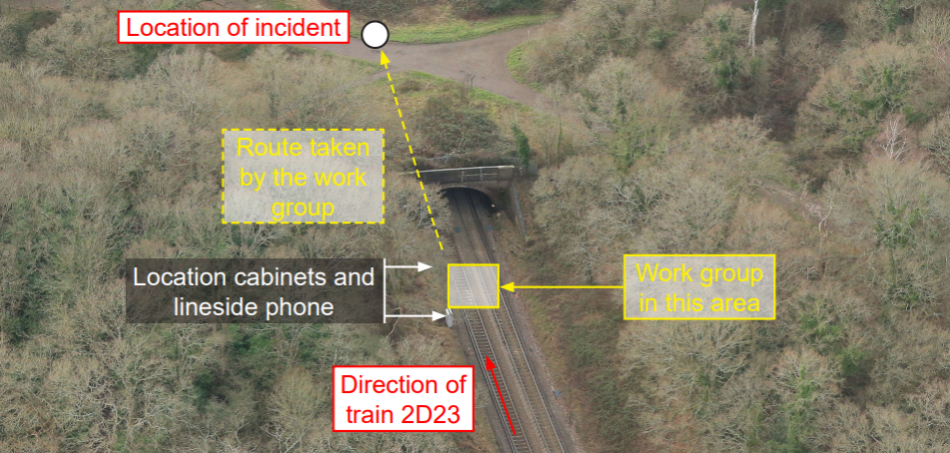
Bookham Tunnel in Surrey, where three track workers were involved in a near miss with a passenger train travelling at around 33 mph. Source: Rail Accident Report (image by Network Rail)
The workers were walking through Bookham Tunnel on the approach to Bookham station when the train approached from behind. Two of the workers moved into tunnel refuges, while the third stood against the tunnel wall as the train passed. No one was injured, but the available space between the tunnel wall and the passing train was only around 1 m to 1.15 m. For railway work at line speeds below 100 mph, a position of safety should be a minimum of 1.25 m from the nearest running rail.
The Rail Accident Investigation Branch found that the team believed they were protected by a line blockage. In reality, the line blockage applied to nearby Mickleham Tunnel, not Bookham Tunnel.
The immediate issue was that the track workers were in a different location from the section that had been blocked to trains. The error originated during the planning stage, when the safe work pack incorrectly included line blockage arrangements for Mickleham Tunnel while the actual work involved telephones at Bookham Tunnel.
The mistake then passed through several checks without being identified. The safe work pack was verified, authorised and briefed, but the mismatch between the work location and the blocked line remained unnoticed. During safety-critical communications, both the person in charge and the signaller referred to information that matched the paperwork, but neither realised that the workers were physically at Bookham Tunnel while the blocked line was at Mickleham Tunnel. Notably, the person in charge mentioned being at Bookham Tunnel in calls to the signaller, yet the discrepancy still went undetected.
This matters because both tunnels are limited-clearance structures. In such locations, workers cannot rely on simply standing aside when trains are running. The safety system depends on absolute clarity over which line is blocked, where the work is taking place and where the safe working limits are.
RAIB identified deeper issues beyond the immediate mistake. One was the lack of a specific process for transferring information between Network Rail’s asset management systems and the software used to produce safe work packs. The other was that steps in the safe work planning process were not always carried out effectively in practice.
The report also highlighted that the planner and the person in charge did not work together as intended when preparing the safe work pack. Checks became too dependent on individuals noticing an error within a large set of documents, rather than on a robust system that made critical location information clear and difficult to misinterpret.
RAIB made three recommendations to Network Rail. These focus on reducing data-transfer errors, improving how safe work planning is implemented, and making better use of RailHub software data for assurance and trend monitoring.
RAIB also issued two learning points, reminding track workers and signallers of the importance of clarity and unambiguous understanding in safety-critical communications, and urging planners and delivery staff to reach a clear agreement on how all planned activities, including walking routes, will be carried out. In an accompanying statement, Chief Inspector of Rail Accidents Andrew Hall said that while the move away from unassisted lookout protection has made track work statistically safer, safety now depends heavily on every worker knowing exactly which lines are blocked and where the safe working boundaries lie. He warned that a pattern of near misses tends to end in tragedy, pointing to an incident in Hertfordshire in March 2026 in which a track worker was struck by a train and lost their life.
The Civil Engineer (thecivilengineer.org) uses third party cookies to improve our website and your experience when using it.
To find out more about the cookies we use and how to delete them visit our Cookies page.
Allow cookies