Rendering of the restored Salt Lake Temple and surrounding Temple Square, showing the completed historic renovation within Salt Lake City’s urban setting. Source: ENR (Image by the the Church of Jesus Christ of Latter-day Saints)
A major restoration and seismic stabilization project is nearing completion at the historic Salt Lake Temple in Salt Lake City, Utah. The 382,207 sq ft Gothic Revival building, first opened in 1893 after 40 years of construction, is being upgraded to improve long-term structural performance in an active seismic region near the Wasatch Fault.
The project has transformed the temple and surrounding Temple Square into a major construction site for several years. The works include restoration of historic interiors, modernization of mechanical, electrical and plumbing systems, and a technically complex seismic retrofit of a historic masonry structure.
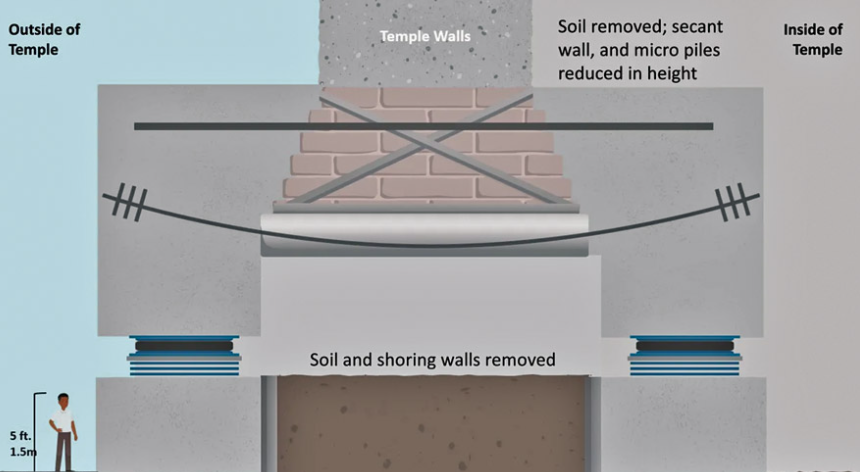
The central engineering solution is a base isolation system designed to allow the temple to move during an earthquake while reducing damaging forces transmitted into the historic superstructure. Instead of removing the original sandstone foundation, the project team developed a method to transfer the building load onto a new isolated support system while preserving the existing foundation.
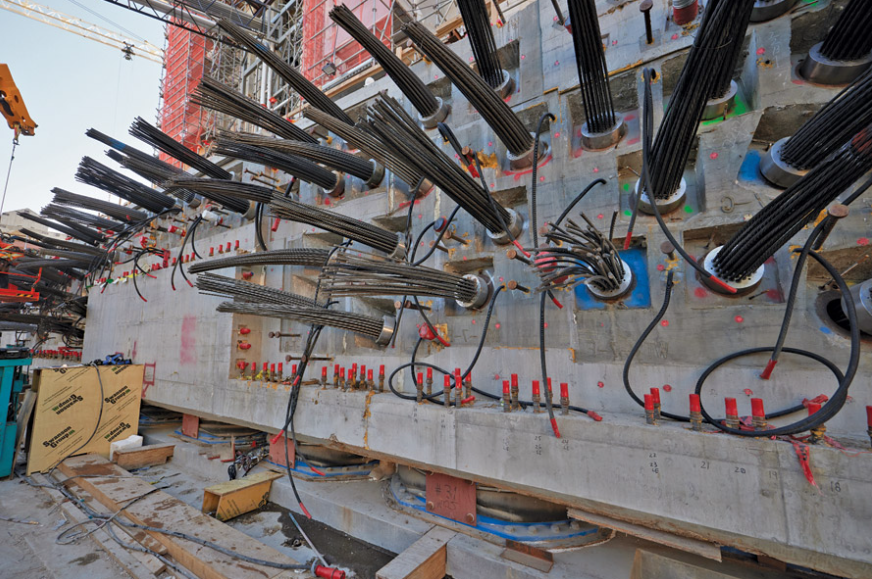
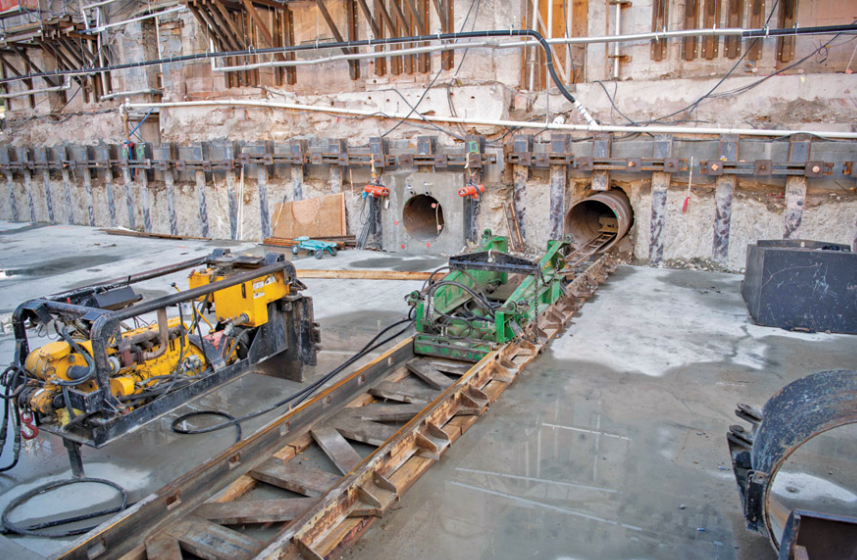
Engineers excavated approximately 17 ft below the original foundation and constructed a new support platform beneath the building. Horizontal reinforced steel pipes were installed below the temple using a jack and bore method. Each pipe was later fitted with reinforcement, post-tensioning cables and grout. Concrete transfer beams were then built to encase sections of the original foundation and connect the load path to the new isolation system.
Post-tensioning cables and reinforced concrete transfer elements forming part of the temple’s seismic stabilization system. Source: ENR (Image by the Church of Jesus Christ of Latter-day Saints)
The project uses 98 base isolators, each engineered to carry more than 8 million lb. These isolators are designed to allow the building to move up to 5 ft in any horizontal direction during a seismic event. This movement capacity is intended to reduce seismic demand on the temple’s historic stone structure.
The stabilization works were made more difficult by the building’s estimated weight of 185 million lb and the nature of its materials. The foundation is sandstone, while the main building is constructed from quartz monzonite, a granite-like stone quarried from nearby canyons. These materials carry significant heritage value but also require careful handling because brittle masonry can be vulnerable during strong shaking.
Jack and bore operations beneath the temple foundation, used to install horizontal steel pipes for load transfer and base isolation works. Source: ENR (Image by the Church of Jesus Christ of Latter-day Saints)
Installing the horizontal steel pipes beneath the temple was particularly difficult. Large stones repeatedly disrupted the boring alignment, forcing workers to enter the pipes and manually clear sections using hand tools and air hammers before jacking could continue. Precise alignment was essential because vertical post-tensioning cables from the temple walls needed to connect accurately to the reinforced base system.
A real seismic test came in March 2020, when a magnitude 5.7 earthquake struck the Salt Lake Valley while works were underway. The event loosened masonry on the temple spires and revealed movement patterns that required further engineering refinement. In response, engineers designed reinforcing steel frames inside the spires and secured them with post-tensioning cables.
Schematic section of the seismic retrofit system, showing soil removal, temporary shoring, transfer beams and base isolators beneath the historic temple walls. Source: ENR (Image by the Church of Jesus Christ of Latter-day Saints)
The Salt Lake Temple project shows how modern seismic engineering can be applied to a historic structure while retaining major elements of its original construction. By combining base isolation, post-tensioning, deep excavation, transfer beams and careful restoration, the project aims to preserve a landmark building while improving its resilience for future use.
The Civil Engineer (thecivilengineer.org) uses third party cookies to improve our website and your experience when using it.
To find out more about the cookies we use and how to delete them visit our Cookies page.
Allow cookies