

In parts of western Alaska, the ground is no longer behaving like ground. In the coastal village of Kwigillingok, along the Bering Sea, some areas now feel soft, wet and unstable — a local symptom of a much larger problem facing communities built on thawing permafrost.
Permafrost has historically acted as a frozen foundation beneath much of Alaska, remaining frozen year-round beneath roughly 80% of the state. It has provided a stable base for homes and businesses, roads, power plants, water treatment facilities and other essential infrastructure. As temperatures rise, that frozen layer is thinning or disappearing, changing the strength, stiffness and drainage behaviour of the ground beneath entire settlements. In some parts of southwestern Alaska the permafrost layer has become almost non-existent, and villages rely on wooden boardwalks because the land cannot support asphalt roadways.
The issue became impossible to ignore after Typhoon Halong struck Alaska's southwestern coast in October 2025. Kwigillingok and the neighbouring village of Kipnuk were largely destroyed by record-setting flooding and wind. Homes were uprooted, power lines were severed and boardwalks were split apart. In Kipnuk, tribal administrator Rayna Paul has described floodwater reaching the village lagoon, the reservoir and the landfill, leaving widespread contamination behind.
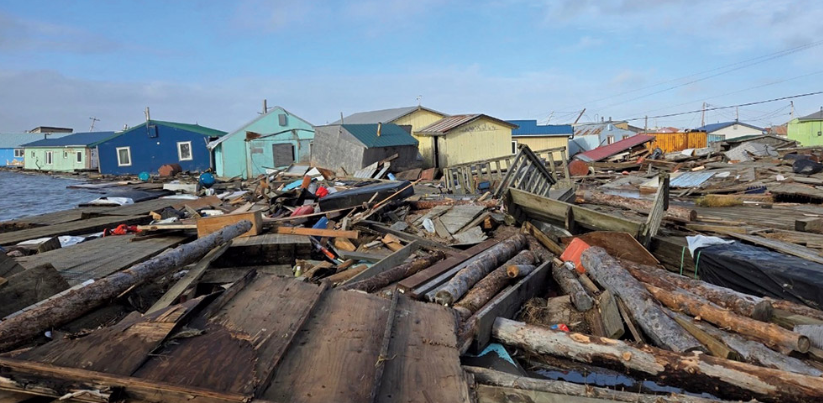
Most residents were evacuated shortly after the storm, to Bethel — the nearest town with an airport, about 80 miles away — or to Anchorage, more than 400 miles distant. In February, Kipnuk voted to relocate to a safer site, despite pressure from state and federal authorities to rebuild in place.
For engineers, thawing permafrost creates a difficult foundation problem. Ground that once behaved like a competent frozen mass can become compressible, waterlogged and highly variable. In practice this can mean settlement, tilting, cracking, loss of serviceability and, ultimately, failure of roads, buried utilities and building foundations. As Kevin Bjella, an Arctic research civil engineer at the U.S. Army Corps of Engineers' Permafrost Tunnel Research Facility near Fairbanks, puts it, once the ice in the ground thaws and the water displaces, thaw settlement at the surface follows — and that is a detriment to most infrastructure.
The problem is not limited to structural support. Permafrost also influences hydrology. Above the permanently frozen ground sits an "active" layer, typically 1.5 ft to 6 ft deep, that freezes and thaws each year. When that layer is disturbed, water infiltrates more easily, drainage patterns change, surface water can pond or flow unpredictably, and the cycle of thaw accelerates. Soils that were previously stable can become more vulnerable to erosion.
There is also a contamination issue. According to Krystal Lapp, interim executive director of the Northern Alaska Environmental Center, permafrost has functioned as a freezer for decades, and as it thaws it can release naturally occurring metals, mercury and nutrients, along with contaminants from former industrial, military, landfill, mining or fuel sites. Once mobile, these materials can move into soils, streams, rivers and aquifers. Speaking in ENR's companion video, "Remnants of a Storm," Lapp argues that the frozen layer has itself acted as a form of protection for aquifers, and that this filtering function is lost as the permafrost melts.
In northern Alaska, that shift is already visible. Rivers across more than 200 watersheds show evidence of iron release from thawing soils, and the National Oceanic and Atmospheric Administration reported in 2025 that ground, aerial and satellite observations had identified clear water turning rusty orange — an abrupt change it characterised as an unanticipated consequence of Arctic permafrost thaw and an emerging risk to water quality and aquatic life. Permafrost degradation, in other words, is not only a foundation concern. It is also a water quality, environmental and public health issue.
The central question for Alaska's vulnerable communities is therefore no longer only how to rebuild. It is whether rebuilding in the same location is safe, durable or, in the view of many of the affected communities, defensible at all.
In some areas, engineering measures may still be viable. These include elevating buildings to allow air to circulate beneath them, placing insulation between new roads or runways and the ground below, thermosiphons, improved drainage and snow removal, erosion protection, and careful control of ground disturbance during construction and operation. Vladimir Romanovsky, professor emeritus at the University of Alaska Fairbanks Geophysical Institute, frames the objective simply: keep the permafrost cold enough not to thaw beneath and around the infrastructure, particularly where it is ice-rich. Such solutions depend on reliable ground investigation, long-term monitoring and realistic assumptions about future thaw, flooding and coastal erosion.
The same logic cuts against large new development on unstable ground. Engineers interviewed by ENR stress minimising disturbance, which raises unresolved questions about the feasibility of the multibillion-dollar oil and gas infrastructure now proposed for the North Slope and the wider state.
In other locations — especially low-lying coastal villages exposed to storm surge and permafrost loss — relocation may be the safer option. That decision is not only technical. It involves culture, funding, land rights, access to services and community self-determination. There is precedent: Newtok, another village near Bethel, decided in 2006 to move to Mertarvik, and its first residents arrived in 2019.
The Alaska case shows that permafrost thaw is changing the rules of infrastructure planning. Ground conditions that once seemed permanent are becoming transitional. For civil and geotechnical engineers, the priority is clear: future design must account for thawing ground, unstable coastlines, changing groundwater and the possibility that some sites may no longer be suitable for long-term occupation.


