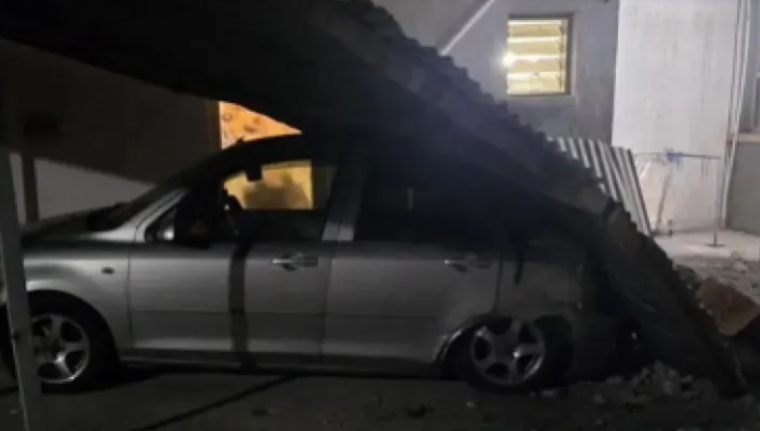
Two balconies collapsed from a 7-storey apartment building in Limassol, damaging a parked car and forcing the evacuation of residents. Source: Kathimerini
Two balconies collapsed from a 7-storey apartment building in Limassol on Monday night, 29 June, damaging a parked car and forcing the evacuation of the building. The incident occurred on a side street off Petrou Tsirou and Ilissou streets, in the Kapsalos-Tricherousa area, when a fourth-floor balcony reportedly gave way and fell onto the balcony directly below it.
No injuries were reported, but the collapse triggered an emergency response from the Limassol District Local Government Organisation and Civil Defence. Engineers were sent to the scene, the area was fenced off, and the building, which contains more than 30 flats, was evacuated while its structural condition was assessed. Civil Defence provided temporary accommodation for around 20 residents who had nowhere else to stay.
Two balconies collapsed from a 7-storey apartment building in Limassol, damaging a parked car and forcing the evacuation of residents. Source: Politis
The case has attracted wider concern because the building had not been officially classified as dangerous. Instead, according to Limassol district governor Yiannis Tsouloftas, it had previously been highlighted by the city’s municipality as being in need of maintenance, after a letter noted damage and disintegration of its external walls and balconies requiring repair.
According to the district governor, the property owners had been asked to appoint a civil engineer and address the issues identified. Following the collapse, he indicated that this appears not to have been done.
Initial inspections after the incident reportedly suggested that the problem may be limited to the balconies rather than the overall load-bearing structure of the building. However, engineers were required to carry out further checks before deciding whether residents could safely return or whether the building should remain empty until the danger is removed.
A building may not be classified as globally unsafe, but local deterioration of balconies, cantilever slabs, external concrete, reinforcement or facade elements can still create serious public safety hazards. Falling concrete from height can be fatal, even when the main structural frame remains stable.
Balconies are particularly vulnerable elements in ageing apartment buildings. They are exposed to rain, temperature changes, carbonation, chloride attack, poor drainage and long-term reinforcement corrosion. Once steel reinforcement corrodes, concrete can crack, spall and lose bond capacity. If maintenance is delayed, a local defect can progress into sudden collapse.
The incident comes less than three months after the partial collapse of the Seagate apartment complex in Germasogeia, where two people were killed. That tragedy intensified public concern over ageing apartment buildings, delayed enforcement procedures and the limited ability of local authorities to act quickly when buildings show signs of deterioration. In the Seagate case, an application for an evacuation order was filed on 20 May, but the matter is still making its way through the courts and the building remains inhabited despite its partial collapse.
Limassol officials have again highlighted that existing legal tools are slow and ineffective when urgent intervention is needed. Even when defects are identified and owners are asked to take action, authorities may still face delays in securing evacuation orders or enforcing remedial works. Tsouloftas has called for legislative amendments that would give district governments the authority to deal with unsafe buildings quickly and effectively.
The collapse in Kapsalos also raises the question of how buildings that fall short of the official “dangerous” classification, but are already known to require maintenance, are monitored and followed up. In this case, defects had been identified and owners notified, yet the deterioration progressed to collapse before repairs were carried out.
For the engineering community, the incident reinforces a familiar lesson: regular inspections, clear owner responsibility, faster enforcement and timely structural repair are essential if local defects are to be addressed before they become public safety emergencies.
The Civil Engineer (thecivilengineer.org) uses third party cookies to improve our website and your experience when using it.
To find out more about the cookies we use and how to delete them visit our Cookies page.
Allow cookies