
UK megaproject puts 39-tonne electric construction haulers to work

Four of the world's largest production electric articulated dump trucks have entered service on the £10 billion Lower Thames Crossing, marking a significant step in the project's ambition to deliver major construction works without conventional diesel-powered machinery.
The four Volvo A40 Electric articulated haulers, the first battery-powered machines in their size class to start work on site anywhere in the world, are being used near East Tilbury in Essex to move gravel, sand, stone and other materials during construction of foundations and structures for the new road and tunnel entrance. They are operated by BMJV, the joint venture between Bouygues Travaux Publics and Murphy delivering the Tunnels and Approaches section, and were supplied by SMT GB, Volvo Construction Equipment's UK dealer.
Each machine can carry up to 39 tonnes in a single load and is equipped with a 540 kWh battery that charges quickly in line with shift patterns. Gautier Tortajada, plant manager and electrical lead at BMJV, said teams had quickly adapted the machines to site operations, establishing charging routines during breaks and in the evening to suit shift patterns, while regenerative braking feeds energy back into the battery during operation.
The machines perform the same heavy-duty earthmoving tasks as conventional articulated dump trucks but without tailpipe emissions, with the operator experience described as similar to a diesel truck but with lower noise and less vibration, both of which also benefit nearby communities.
Electric construction plant normally faces challenges related to charging infrastructure, duty cycles and the high energy demand of heavy earthmoving equipment. On the Lower Thames Crossing, the trucks are charged using electricity generated on site from British-produced green hydrogen, creating a temporary energy system designed around the requirements of electrically powered plant.
The project's wider construction strategy is also intended to eliminate fossil fuels from site. Diesel has not been used on its worksites since 2025, with the tunnels and road being built only using machinery powered by hydrotreated vegetable oil, electricity or hydrogen.
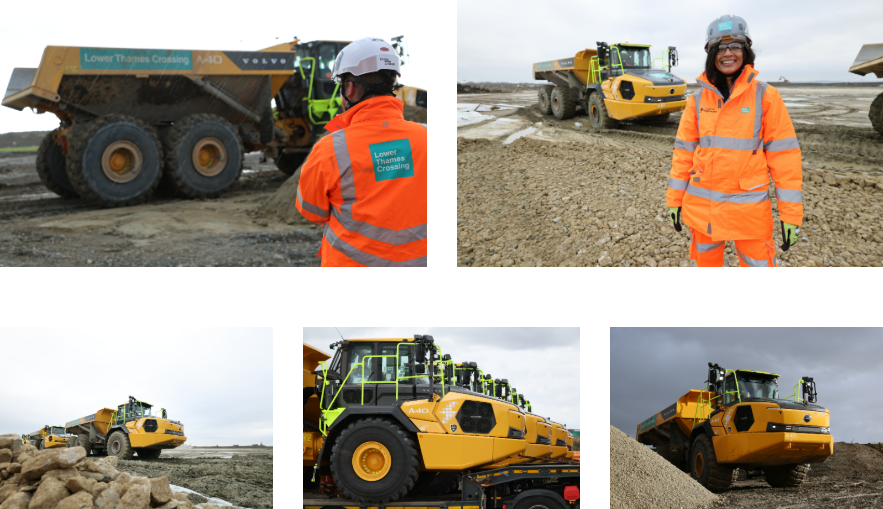
Although battery-electric machines carry a higher initial purchase cost, the project expects them to prove cheaper than diesel and HVO alternatives over their lifetime, with electricity cheaper than imported fossil fuels and lower maintenance requirements reducing the cost of ownership while increasing time spent working on site. Darren Fitch, head of strategic accounts at Volvo CE, said that when a project of this profile chooses electric the whole industry takes notice, adding that it is no longer a question of why to do it but how quickly it can be scaled up.
Shaun Pidcock, Lower Thames Crossing programme director, said going electric no longer means compromising on size, power or productivity, and that using the next generation of construction machinery was helping the industry set a new standard and make diesel-powered sites a thing of the past.
The Lower Thames Crossing will create a new highway connection between Kent and Essex beneath the River Thames and is expected to almost double road capacity east of London. Early preparation work in Essex and Kent began in March 2026, with major construction and tunnelling due to start in 2028. More than 3,000 people are now employed on the programme, 49% of them recruited from the local area, and the crossing is expected to open in the early to mid-2030s.
National Highways says it will be the first major UK project to be carbon neutral in construction, although this relates specifically to the delivery phase rather than the environmental impact of road traffic once the crossing becomes operational. Andrea Griffiths, director of the Kent branch of the Campaign to Protect Rural England, said the measures did not counter the fact that any road is ultimately bad for the environment, and called for proper investment in long-term solutions including moving freight from road to rail and a possible Kent-Essex rail or tram connection. Katharina Ferguson, supply chain and sustainability director for the project, said the team had worked with stakeholders to minimise environmental impact, including turning 1,200 hectares of land into nature spaces such as parks.
For the construction sector, the deployment of 39-tonne battery-powered haulers represents an important practical test. If electric machinery can maintain productivity, charging availability and acceptable lifecycle costs on a project of this scale, similar systems could become increasingly viable across major earthworks, tunnelling and infrastructure programmes.
Sources: nationalhighways.co.uk, bbc.com
Want to read more like this story?

Taipei 101’s impressive tuned mass damper
Apr, 03, 2024 | NewsTaiwan was struck on Wednesday, April 3, 2024, by the most powerful earthquake it has experienced i...

Characteristics of Load Bearing Masonry Construction
May, 23, 2019 | NewsLoad bearing masonry construction is a building technique in which wall elements are used as the fra...

Understanding the Carola Bridge Collapse: Expert Insights
Dec, 30, 2024 | NewsThe sudden collapse of the Carola Bridge in Dresden on September 11, 2024, highlights the critical...

This powder offers an innovative solution to water purification
Aug, 11, 2017 | NewsA small Japanese company has developed a special powder that could improve water quality in developi...

Dutch greenhouses have revolutionized modern farming
Feb, 06, 2018 | NewsAt optimal growing conditions, each acre in the greenhouse yields as much lettuce as 10 outdoor acr...

The Billion-Dollar Airport Boom: 2025 Megaprojects Shaping the Skies
Jan, 14, 2025 | NewsAs air travel rebounds and infrastructure demands rise, U.S. airports are undergoing massive transf...

AI-Powered Bridge Monitoring: Detecting Structural Failures Before They Happen
Feb, 10, 2025 | NewsBridges are critical components of transportation networks, yet their maintenance often relies on r...

Transatlantic Tunnel: A Bold Vision or an Impossible Dream?
Mar, 04, 2025 | NewsImagine traveling from New York to London in just 54 minutes—a journey that currently takes over se...

Foundations and structural design of the Torre Rise Supertall Tower: Construction progress in images
Mar, 09, 2026 | NewsConstruction of the Torre Rise skyscraper in Monterrey has reached a major milestone, with the stru...
Trending


Nairobi’s 22-Storey collapse turns fatal as construction failures continue to repeat

Solar Farms and Wind Turbines Tested and Failed by Storm Darragh

Deck failure creates large hole in Quebec bridge

$4.7 billion contract awarded for the construction of Neom’s artificial lake

Formwork failure causes roof slab collapse in Limassol construction site

