
Cochin International Airport launches 25-year master plan amid $426M expansion programme

Cochin International Airport in southern India has launched a 25-year master planning programme to guide major long-term expansion of its terminal, airside, cargo and landside infrastructure.
The airport, located northeast of Kochi in Kerala, handled approximately 11.3 million passengers in the latest fiscal year and is preparing for continued growth in both passenger and freight traffic. International travellers have accounted for roughly 47% of passenger traffic over the past three years.
The new master plan will assess how the airport should develop over the next quarter century, including the possible need for a second runway, additional taxiways, expanded passenger and cargo facilities, improved ground transportation and additional land for future development.
These elements are currently being assessed as planning alternatives rather than confirmed construction projects.
The work comes as the airport prepares to invest approximately $426 million in capital projects through March 2031. Current plans include expansion of Terminal 1 and associated airside facilities, modifications to the cargo complex, development of a new pier at Terminal 3 and investment in safety systems, information technology, scanning equipment, airport buildings and road infrastructure.
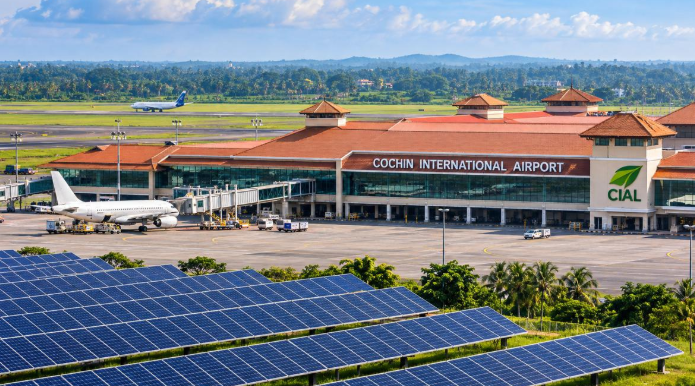
Airside planning will examine infrastructure such as runways, taxiways, aprons, air traffic control facilities, technical systems, perimeter roads, fuel infrastructure, airfield lighting and navigation aids. Landside planning will consider passenger and cargo terminals, parking, commercial areas, approach roads, multimodal transport and supporting facilities.
The airport's longer-term challenge will be to increase capacity while maintaining operations and integrating future infrastructure into an already active site. Runway and taxiway development in particular will require careful consideration of aircraft movements, terminal interfaces, land availability and future traffic demand.
An environmental and social impact assessment framework will also be incorporated into the master plan to support future project development and help balance expansion with environmental and community considerations.
Cochin International Airport began commercial operations in 1999. Terminal 3, which opened in 2017, has a reported capacity of approximately 14 million passengers per year.
The airport is also notable for operating entirely on solar power, making sustainability a central consideration as future capacity is planned. Long-term development will therefore need to address both growth and resilience while maintaining the airport's existing renewable-energy-based operational model.
The 25-year study is scheduled to be completed within approximately 10 months. Its recommendations will provide the framework for determining which major infrastructure projects should proceed, when they should be delivered and how they should be phased as passenger and cargo demand develops.
Sources: highways.today, www.businesswire.com, enr.com
Want to read more like this story?

Taipei 101’s impressive tuned mass damper
Apr, 03, 2024 | NewsTaiwan was struck on Wednesday, April 3, 2024, by the most powerful earthquake it has experienced i...

Characteristics of Load Bearing Masonry Construction
May, 23, 2019 | NewsLoad bearing masonry construction is a building technique in which wall elements are used as the fra...

Understanding the Carola Bridge Collapse: Expert Insights
Dec, 30, 2024 | NewsThe sudden collapse of the Carola Bridge in Dresden on September 11, 2024, highlights the critical...

This powder offers an innovative solution to water purification
Aug, 11, 2017 | NewsA small Japanese company has developed a special powder that could improve water quality in developi...

Dutch greenhouses have revolutionized modern farming
Feb, 06, 2018 | NewsAt optimal growing conditions, each acre in the greenhouse yields as much lettuce as 10 outdoor acr...

The Billion-Dollar Airport Boom: 2025 Megaprojects Shaping the Skies
Jan, 14, 2025 | NewsAs air travel rebounds and infrastructure demands rise, U.S. airports are undergoing massive transf...

AI-Powered Bridge Monitoring: Detecting Structural Failures Before They Happen
Feb, 10, 2025 | NewsBridges are critical components of transportation networks, yet their maintenance often relies on r...

Transatlantic Tunnel: A Bold Vision or an Impossible Dream?
Mar, 04, 2025 | NewsImagine traveling from New York to London in just 54 minutes—a journey that currently takes over se...

Foundations and structural design of the Torre Rise Supertall Tower: Construction progress in images
Mar, 09, 2026 | NewsConstruction of the Torre Rise skyscraper in Monterrey has reached a major milestone, with the stru...
Trending


Nairobi’s 22-Storey collapse turns fatal as construction failures continue to repeat

Solar Farms and Wind Turbines Tested and Failed by Storm Darragh

Deck failure creates large hole in Quebec bridge

$4.7 billion contract awarded for the construction of Neom’s artificial lake

Formwork failure causes roof slab collapse in Limassol construction site

