AI in construction must focus on design validation and delivery risk. Source: Global Risk Institute
Artificial intelligence is becoming a major topic in design and construction, but project management firms need more than broad promises about automation. Their real challenge is practical delivery. Projects are larger, faster and more complex, while teams are still expected to control cost, quality, programme and risk with limited resources.
This pressure is especially visible in design-build and construction management at-risk delivery models, where early decisions can strongly influence final cost and programme certainty. As project information moves between designers, contractors, owners, consultants and specialist suppliers, small inconsistencies can become costly downstream problems.
Design review remains a hidden bottleneck
Design review remains one of the most time-consuming and fragile parts of project delivery. Teams work across BIM models, IFC files, CAD drawings, PDFs, schedules, specifications and site records. Each file may be correct in isolation, but still inconsistent with another part of the project information.
A drawing may not reflect the latest instruction. A BIM model may include the right elements but contain missing attributes or inconsistent naming. A PDF package may show an older design decision that has not been properly carried into the model. These issues are not always obvious, but they create uncertainty.
Many review processes still depend heavily on manual checking. Review logic is often spread across spreadsheets, markups, email trails, disconnected checklists and individual experience. This creates variation between teams and makes quality assurance difficult to repeat from one project to another.
For project management firms, this is not only a technical issue. It can affect approvals, procurement, sequencing, claims, change orders and client confidence. A minor inconsistency during design can later delay installation, create rework or trigger commercial disputes.
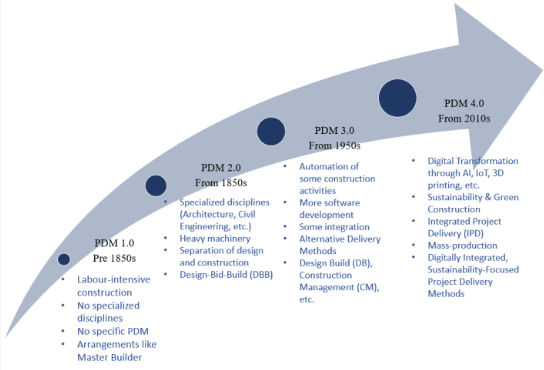
Evolution of project delivery methods from more traditional, labour-intensive approaches toward more digitally integrated and collaborative delivery models. Source: MDPI
What useful AI should actually do
The most valuable use of AI in construction is not replacing engineers, architects or project managers. It is helping them review information more consistently and detect issues earlier.
Useful AI should support practical design validation. It should help teams compare drawings, check model attributes, identify missing information, flag inconsistencies between documents and apply repeatable rules across similar projects. It should work with the file formats teams already use, including BIM, IFC and PDF workflows.
This is particularly important for project management firms operating across multiple packages and stakeholders. AI tools should strengthen traceability, standardise repetitive checks and reduce the risk of important review items being missed because of time pressure.
The benefit is not only speed. The greater value is consistency. If firms can capture review logic once, improve it over time and apply it across projects, technical quality becomes more scalable. Experienced staff can then focus on judgement, risk decisions and coordination, rather than spending excessive time on repetitive information checking.
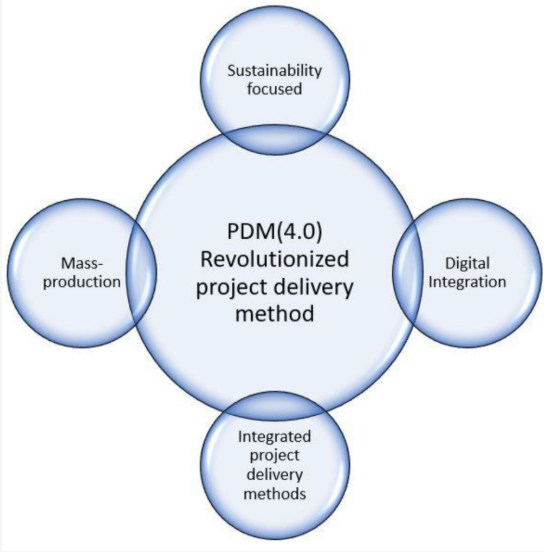
Key features of PDM 4.0, showing how modern project delivery is shaped by digitalisation, sustainability, mass production principles and integrated delivery methods. Source: MDPI
From technology experiment to delivery advantage
The firms that benefit most from AI will likely be those that embed it into delivery workflows, rather than treating it as a side experiment. In complex projects, early validation can become a competitive advantage because it helps reduce uncertainty before risk is locked into cost, procurement and programme decisions.
This matters even more as project delivery models shift toward earlier collaboration, faster decisions and stronger risk alignment. Design-build and CMAR teams need reliable information at the front end, where decisions on scope, phasing, systems and cost have the greatest impact.
AI will not solve poor coordination by itself. However, if used correctly, it can make coordination more disciplined. It can help teams detect gaps earlier, support better decision-making and reduce the amount of avoidable rework that reaches site.
For project management firms, the practical value of AI should be measured through fewer bottlenecks, clearer information, stronger quality control and better delivery outcomes.
The Civil Engineer (thecivilengineer.org) uses third party cookies to improve our website and your experience when using it.
To find out more about the cookies we use and how to delete them visit our Cookies page.
Allow cookies