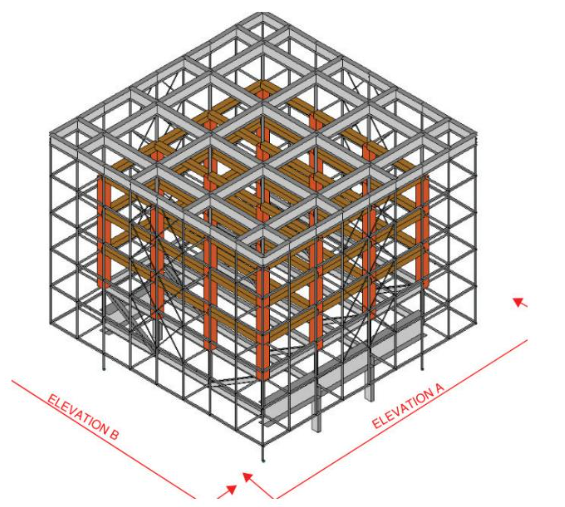
Exterior view of the research campus complex during renovation, showing the three primary structural volumes: the main laboratory building, the auditorium block, and the central circulation staircase known as the “spider.” Source: Structure Magazine
The modernization of the 23-story “Avenue” research building demonstrates how structural engineering can enable major functional upgrades within an existing reinforced concrete high-rise. Originally built in the 1990s, the building contained laboratories, residential spaces, and public areas that no longer met the spatial and technical demands of modern research facilities. A renovation program targeted approximately 120,000 square feet across floors two through six to create flexible laboratory environments capable of supporting contemporary scientific work.
Achieving this transformation required relocating mechanical shafts and plumbing risers that were originally positioned within the structural bays of the concrete floor system. The existing superstructure consisted of one-way and two-way reinforced concrete flat slabs with localized drop caps at selected columns. Introducing new mechanical openings and relocating risers significantly reduced punching shear capacity at slab-column connections. Without intervention, the structural system would have experienced overstress and excessive deflections once the new penetrations were introduced.
At the same time, construction had to occur while the building remained operational. Research activities continued in other floors, utilities served adjacent buildings, and noisy works such as drilling and jack hammering had to be limited. Additionally, the building had undergone several undocumented modifications over the years, meaning accurate as-built mechanical drawings were unavailable. These conditions required a strengthening strategy capable of adapting to unforeseen constraints during construction.
Structural Analysis and Evaluation of Strengthening Options
The design team first established a structural baseline using two finite element models developed in CSI SAFE. One model represented the existing slab system with its current penetrations, while the second incorporated the proposed mechanical shafts and relocated risers. Comparing the models allowed engineers to identify areas where redistributed loads would overstress the slab and to quantify the strengthening required to maintain code compliance.
Several strengthening methods were evaluated. Fiber-reinforced polymer (FRP) strips were considered because they are lightweight and minimally intrusive to mechanical systems located above the ceiling. However, analysis showed that the magnitude of moment increases near the new openings exceeded the strengthening capacity that FRP alone could provide.
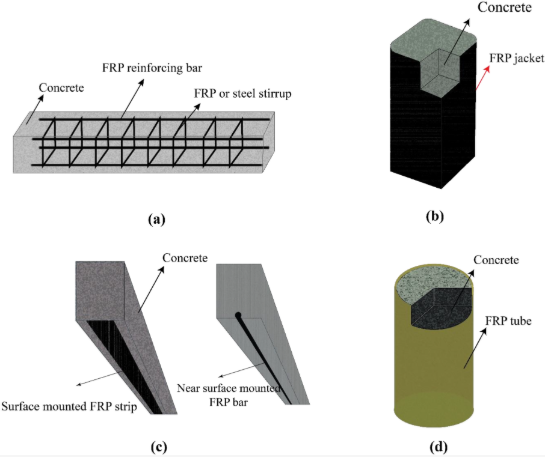
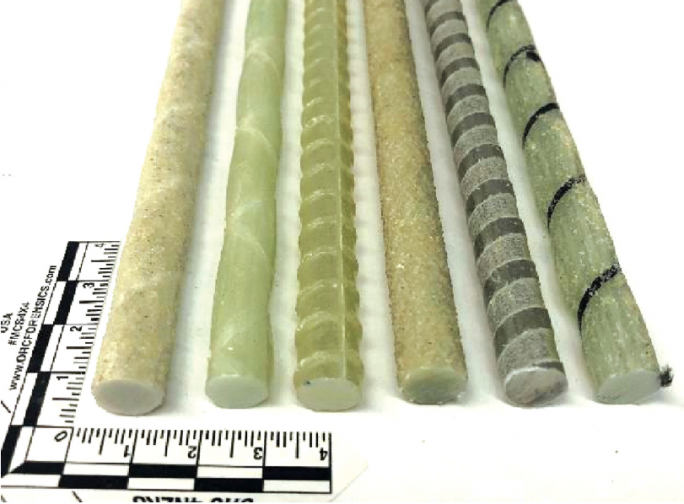
Typical strengthening configurations using fiber-reinforced polymer (FRP) in concrete members, including FRP reinforcing bars, FRP-wrapped columns, near-surface mounted (NSM) FRP strips/bars, and concrete-filled FRP tubes used to enhance flexural strength, confinement, and durability. Source: MDPI article
Adding reinforced concrete sections was another possibility. This approach would have required drilling and epoxying large numbers of reinforcing bars into the existing slabs and beams, followed by casting additional concrete layers. Although this method would increase flexural capacity, it posed significant practical challenges. Existing plumbing utilities and electrical conduits embedded in the slab would complicate installation, and extensive drilling would generate noise that could disrupt building occupants.
Steel plating anchored to the concrete slabs was also assessed but presented similar challenges related to post-installed anchors and construction disturbance. Given the uncertainties associated with embedded utilities and the need to maintain building operations, the design team sought a solution that reduced reliance on extensive drilling while maintaining structural performance.
Steel Framing and Hybrid Strengthening Strategy
The final design adopted a hybrid strengthening approach centered on structural steel framing. Steel beams were introduced around the new slab openings, allowing loads from the surrounding concrete slab to be transferred directly to the columns rather than relying solely on the existing slab reinforcement. By redistributing forces in this way, the demand on the concrete slabs was significantly reduced.
To transfer beam reactions safely into the existing columns, engineers installed steel jackets around selected columns. These jackets provided confinement and served as connection interfaces for the new beams. Adhesive anchor rods connected the beams to the steel jackets, while through-bolts enhanced confinement and reduced the risk of concrete breakout. Oversized holes drilled in the concrete were filled with epoxy or grout to prevent reductions in axial column capacity.
Because column dimensions at the lower floors were relatively small, drilling long through-bolt holes presented alignment challenges. The contractor addressed this by scanning the columns to identify reinforcement locations, drilling holes from multiple faces, and fabricating custom steel jackets tailored to each column. This method ensured precise installation while minimizing field adjustments.
Steel framing proved especially valuable during demolition, when previously unknown plumbing mains serving the entire building were discovered. Since these utilities could not be shut down, the steel framing layout was quickly adjusted to accommodate them without delaying the construction schedule. In areas away from the new openings, FRP strips were still applied locally to address redistributed bending stresses.
Additional strengthening measures included steel drop caps with stiffener plates installed at certain beam-column joints to improve punching shear resistance. These drop caps also shortened effective slab spans, reducing bending demands and limiting the need for extensive FRP reinforcement.
The renovation of the Avenue building illustrates how combining analytical modelling with adaptable construction techniques can unlock the potential of existing structures. By integrating steel framing, column jackets, and selective FRP reinforcement, engineers were able to introduce large mechanical openings and modern laboratory infrastructure while preserving the integrity of the original concrete high-rise. The project demonstrates a practical approach to upgrading aging research facilities without compromising building functionality during construction.
The Civil Engineer (thecivilengineer.org) uses third party cookies to improve our website and your experience when using it.
To find out more about the cookies we use and how to delete them visit our Cookies page.
Allow cookies