
Peru braces for super El Niño as major flood protection works remain unfinished

Peru is entering a potentially severe El Niño season with major flood protection projects still under construction across the country's northern coastal regions, where rivers, cities and archaeological sites are already beginning to feel the effects of intensified rainfall.
The current coastal El Niño is expected to remain exceptionally strong through February 2027 before gradually weakening towards June. By late October, the Tumbes, Piura and Chira rivers had already risen sharply, while forecasts indicated that parts of Piura and Tumbes could receive more than 100 mm of rainfall during November. Around 982 districts have been placed under a state of emergency.
The situation is drawing particular attention because northern Peru is still completing a large resilience programme launched after the destructive 2017 coastal El Niño. That event brought months of intense rainfall, floods and mudslides, killing more than 150 people, displacing around 1.7 million and damaging roads, bridges and other critical infrastructure.
A major reconstruction programme was subsequently developed through a government-to-government agreement between Peru and the United Kingdom. The programme covers flood protection across 17 river basins and five ravines in seven cities, together with six city-scale drainage schemes.
One of the largest schemes is Quebrada El Leon, upstream of Trujillo. The system uses 35 dikes together with retention basins, sediment traps, tunnels and protected channels to slow and redirect runoff that can reach approximately 50 m3/s before discharging towards the Moche River.
However, much of the wider programme remains incomplete. Three flood protection schemes have been delivered, while 13 river and gully projects and three urban drainage systems are still under construction. Responsibility for the remaining works is transferring to Peru's National Infrastructure Authority as the current delivery agreement reaches its end.
The coming months will therefore provide an early test of both completed and partially delivered infrastructure. Flood channels and retention systems will need to manage high sediment loads as well as water, while inspection, sediment removal and repairs are expected to be necessary after individual storm events.
The risk extends beyond modern infrastructure. More than 10,000 archaeological sites along Peru's coast are also considered vulnerable to intense rainfall and flooding, particularly structures constructed from adobe and other clay-based materials. Erosion, surface runoff and concentrated flows can rapidly damage walls and archaeological surfaces that have survived for centuries in normally arid conditions.
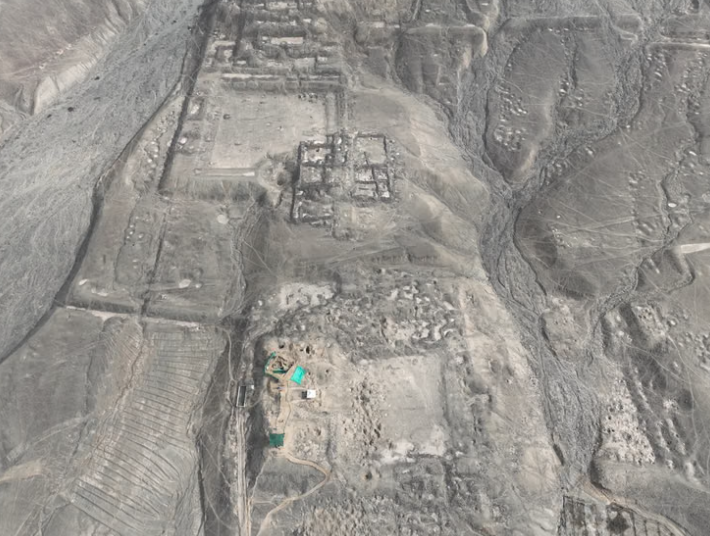
Emergency protection has been directed towards hundreds of priority heritage sites, including Chan Chan, Sican and Tucume, although many smaller archaeological locations remain exposed. Typical protective measures include improving drainage, covering exposed surfaces, reinforcing vulnerable structures and limiting excavation during the wettest periods.
The challenge facing Peru is therefore broader than floodwater alone. The coming El Niño will test river engineering, urban drainage, erosion control, maintenance systems and the resilience of infrastructure and heritage distributed across one of the world's most climatically sensitive coastal environments.
For many of the new flood protection systems, the coming season may provide their first major real-world test. For those still under construction, the priority will be to manage risk while completing infrastructure intended to prevent a repeat of the destruction experienced in 2017.
Sources: enr.com, hardhatreport.com, theartnewspaper.com
Want to read more like this story?

£200M Leeds Flood Scheme Safeguards Homes, Businesses, and Biodiversity
Nov, 26, 2024 | NewsThe Leeds Flood Alleviation Scheme is a landmark £200 million project aimed at protecting over 4,0...

The Devastating Impact and Solutions to Flooding in Brazil
May, 20, 2024 | NewsThe recent catastrophic flooding in Rio Grande do Sul, Brazil, has brought widespread devastation a...

Flooding in China Causes Landslides and Leaves Over 170 Dead
Jul, 12, 2016 | NewsLast week, widespread flooding in the Yangtze river basin in China has left over 170 dead and millio...

Flood-induced failure collapses bridge in Michigan as record river levels hit infrastructure
Apr, 16, 2026 | NewsSevere flooding in northern Michigan has led to the collapse of the Beitner Bridge in Grand Traverse...

Major flood defense project in UK completed
Sep, 01, 2021 | NewsA project that lasted for 20 years and aims at defending a vulnerable region to flooding in the UK h...

Trojena 4.7bn NEOM reservoir project stopped, leaving partial infrastructure challenges
Apr, 10, 2026 | NewsThe $4.7bn (£3.7bn) artificial lake and dam project at Trojena, part of Saudi Arabia’s NEOM developm...

Wisconsin engineers create flood risk prediction tool for Lower Mississippi River Basin
Oct, 17, 2025 | NewsResearchers at the University of Wisconsin have introduced a new computer model designed to predict...

USD100bn Louisiana spaceport plan brings industrial-scale launch infrastructure to the Gulf Coast
Aug, 27, 2026 | NewsSpaceX has announced plans for a USD100bn spaceport across 125,000 acres in Vermilion Parish, Louisi...

Stunning bridge collapse triggered a cliff failure in Peru
Dec, 27, 2019 | NewsA part of a road and a bridge were completely destroyed after being hit by extreme floods and a cli...
Trending

Taipei 101’s impressive tuned mass damper

Characteristics of Load Bearing Masonry Construction

Understanding the Carola Bridge Collapse: Expert Insights

This powder offers an innovative solution to water purification

Dutch greenhouses have revolutionized modern farming

Formwork failure causes roof slab collapse in Limassol construction site

